Upland water in Britain is usually clean enough that most walkers drink it without treatment and notice nothing. That is a statement about probability, not about safety. A stream that runs through sheep pasture, a bothy outflow, a bog pool with a dead animal upstream, or a source below a popular camping spot all carry a risk that increases with the number of people and animals upstream. The obvious approach is to boil everything, which works and costs fuel and time. The better approach is to understand what each method removes, because the methods are not interchangeable.
Treatment is a trade between three things: the size of the organism, the clarity of the water, and the conditions on the day. A frozen filter, a litre of silty water and a group of six all change the correct answer.
Three classes of organism
The organisms that matter fall into three groups, and the groups differ mainly in size.
Protozoa are the largest, and the two usually discussed in hill water are spread by animal faeces. They are robust in the environment and resistant to chlorine at the doses and contact times typical of field use. Because they are large, they are the easiest class to remove by filtration.
Bacteria are smaller and include the organisms responsible for the common intestinal illnesses. They are vulnerable to chlorine, to filtration and to heat.
Viruses are smaller still, small enough to pass through most field filters. They are more of a concern where human waste contaminates a source, and in regions with different sanitation, than in high, remote catchments.
The practical consequence is that no single simple method covers all three. A filter covers protozoa and bacteria. Chlorine covers bacteria and viruses reasonably and protozoa poorly. Boiling covers everything, since heat rather than chemical action does the work.
Pore size and the mechanical answer
A mechanical filter passes water through a medium with holes small enough to hold back the organisms above the pore size. A pore size of around 0.1 to 0.2 microns is typical for hollow-fibre and ceramic field filters, which is small enough to remove protozoa and bacteria and too large to remove viruses.
Hollow fibre is a bundle of fine tubes with porous walls. It is light, it flows quickly when new, and it cannot be scrubbed. Backflushing with clean water pushes the collected material out and restores most of the flow, and there is a point at which backflushing no longer helps and the cartridge is finished.
Ceramic filters use a porous ceramic element that can be scrubbed clean and used again and again. They are heavier, they are brittle, and the flow rate falls as the surface loads with silt. Their advantage is serviceability: a ceramic cartridge can be cleaned in the field with a scouring pad, so a long trip on silty water remains possible.
Field filters come as pump units, gravity bags and squeeze bottles. Pump units are fast and controlled but tiring. Gravity systems move a large volume with no effort at all, which matters with a group, and they take time to set up. Squeeze systems are light and best suited to one or two people. All three deliver the same water quality if the cartridge is intact and the seals are sound.
Chemicals and contact time
Chemical treatment is light, cheap and effective against the organisms it reaches, and it depends entirely on contact time.
Chlorine dioxide is the usual choice for field tablets because it is more effective against protozoa than plain chlorine, though it needs a longer contact period for them than for bacteria. Cold water slows the reaction considerably, so contact times lengthen as the water gets colder, and turbid water shields organisms from the chemical. Standard dosing typically runs to around half an hour for clear, temperate water, with longer times in the cold and considerably longer where protozoa are the concern.
Iodine is effective and cheap, with an unpleasant taste, and it is unsuitable for some people for medical reasons. Chlorine in the form of household bleach works at careful doses, and it attacks some containers and clothing.
Chemicals leave no residual protection once the water is treated, and they do not remove sediment.
Ultraviolet and boiling
Ultraviolet devices expose water to a lamp that damages the DNA of organisms. They are fast, they leave no taste, and they have three conditions. The water must be clear, because suspended particles shield organisms from the light. The device needs power and a charged battery. And the volume treated per cycle is small, which makes the method slower for a group than a gravity filter.
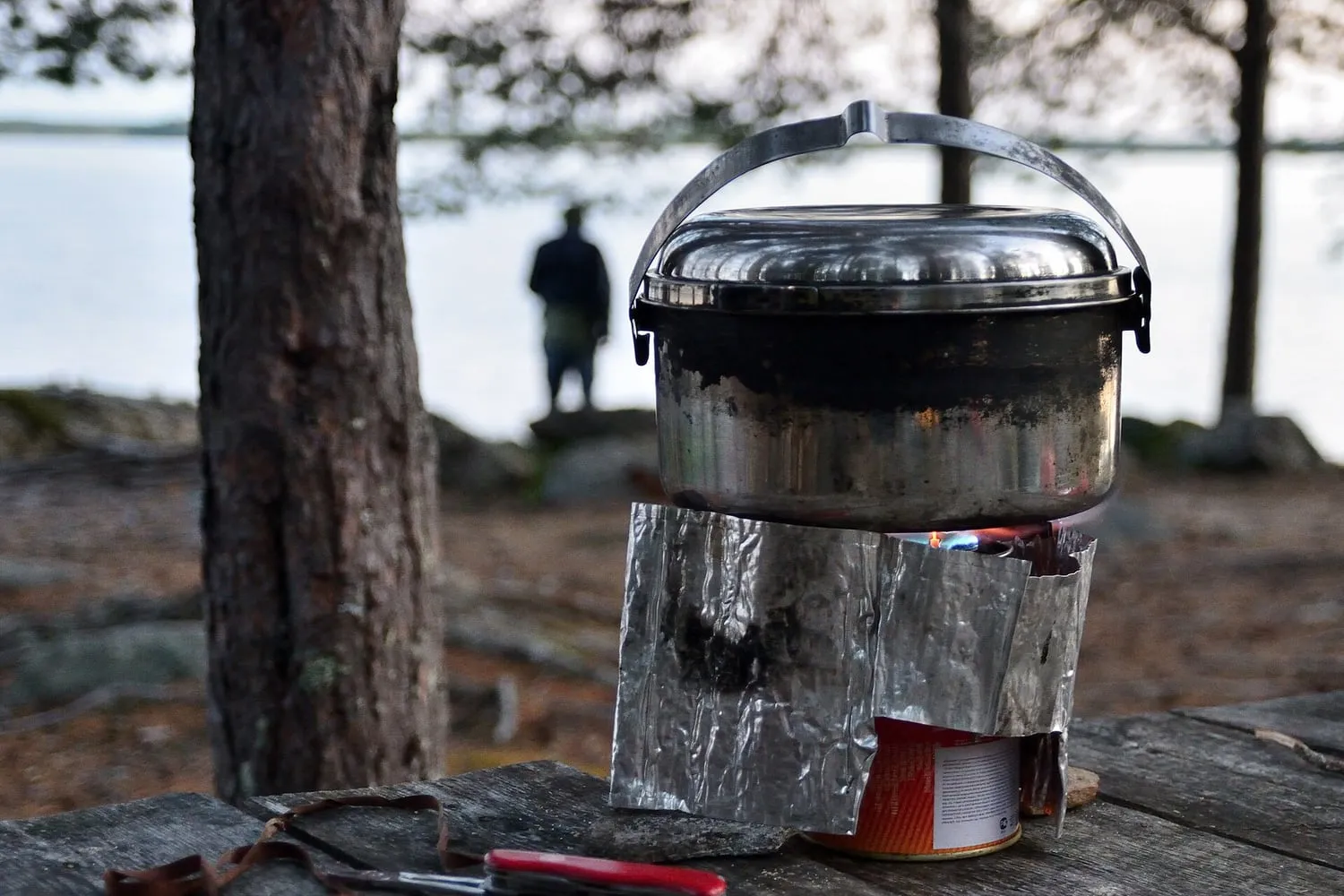
Boiling is the reference method. Bringing water to a rolling boil kills the organisms that matter, and it works on clear or cloudy water, at any turbidity, with no consumable parts. Water does not need to boil hard for long: pasteurisation happens well below boiling point, so the margin is large. The cost is fuel, time and the need to carry water away from the source before heating it.
Boiling point falls with altitude, which changes fuel consumption rather than effectiveness at the altitudes reached by European hillwalkers.
Turbidity, pre-filtering and the frozen limit
Silt and organic matter are the most common reason a method fails in practice.
Turbidity blocks filters, from the outside in, and reduces the flow long before the cartridge is spent. Pre-filtering is the answer: let the water stand so the solids settle, draw from the surface, and pour it through a cloth, a bandana or a fine mesh before it reaches the filter. On glacial or peat-stained water, this step roughly doubles the life of a cartridge.
Turbidity also reduces the effectiveness of ultraviolet and, by shielding organisms, of chemicals. Clear water is a prerequisite for both.
Freezing is the hard limit on two methods. Ice crystals disrupt the pores of a hollow-fibre cartridge, so a filter that has frozen is no longer trustworthy, and manufacturers usually specify replacement after freezing. The safe habit is to sleep with the filter in a jacket or a sleeping bag in cold weather. Ultraviolet devices depend on batteries, whose capacity falls sharply in the cold.
Groups, storage and cross-contamination
Group size changes the method more than any other factor. Gravity systems and pumps deliver litres at a time, which is what a group needs. Tablets and ultraviolet units treat small volumes, so both become slow when four people are waiting.
Storage and handling are where clean water becomes contaminated again. Keep the outlet and the bottle mouth separate from the inlet and the source, do not dip a clean bottle into a stream, and do not treat water in a container that has held untreated water without rinsing it.
A method for the conditions
- For clear, fast-flowing water in a remote catchment, a filter is fast and leaves no taste.
- For water of doubtful clarity, settle and pre-filter first, then filter or boil.
- For chemical treatment, extend the contact time in cold water and use it only on reasonably clear water.
- Carry a second method on any trip where a failure would mean walking out: tablets as a backup for a filter, or a filter as a backup for tablets.
- Keep filters and batteries warm and unfrozen, and treat a frozen filter as finished.
- Boil when the source is suspect, the clarity is poor, or the group is large, and count the fuel as part of the trip’s planning.