Most stove buying starts with the burner, and the burner is the least interesting part of the system. What decides whether a litre of water boils in four minutes or in twelve is the fuel, the pot, the lid, the wind and the temperature of the canister. Two identical burners can differ substantially in fuel consumption depending on what surrounds them. The useful way to read a cooking system is therefore as a chain, where every link costs either weight, money or waiting time.
The evidence is easy to find on any windy pitch. A burner that boils quickly in a kitchen can struggle beside a wall in a March wind, and the difference is rarely the flame.
What efficiency means in practice
Every stove converts the chemical energy in its fuel into heat, and a fraction of that heat enters the pot. The rest is lost upwards around the sides, lost to the cold air, or absorbed by the metal of the burner and the pot support.
The variables that move the fraction most are the same for all fuel types.
- Wind, which strips heat from the pot walls and can be worth more than any other factor.
- Pot and lid, since an uncovered pot loses a large share of its heat as steam, and a wide pot exposes more surface area to a flame than a narrow one of the same volume.
- Heat exchanger bases, which increase the surface area under the pot and improve transfer, at the cost of weight and a pot that suits only its own stove.
- Ambient temperature, which decides how readily the fuel turns into vapour.
The most common mistake is to compare stoves by burner output. Output is a peak figure that says nothing about how much heat reaches the water, and a high-output burner with no wind protection wastes more than a modest one with a screen.
Canister gas and the cold
Canister gas is a blend of liquefied gases, most often butane, isobutane and propane in varying proportions. The blend matters because the three have different boiling points, and a canister delivers gas at a useful rate only while its contents can vaporise. As the canister empties, the liquid inside cools through evaporation, which reduces the vapour pressure further, so the last third of a canister performs noticeably worse than the first.
This is why a canister that works well in summer can falter near freezing. Blends with more propane hold pressure at lower temperatures than blends built around butane. Two techniques help in the cold: warm the canister before use, by carrying it inside a jacket or standing it in a shallow dish of water, and invert the canister so the stove draws liquid rather than vapour, which requires a stove designed to accept it. Both approaches need care, since a heated canister raises pressure.
Canisters are convenient, clean and consistent, and they cannot be refilled at home. Availability varies by country, connecting fittings differ between regions, and empty canisters have to be carried out. For a long trip through several countries, the fitting on the stove is a planning question rather than a detail.
Liquid fuel and priming
Liquid fuel stoves burn white gas, paraffin, petrol or diesel depending on the design and the jets fitted. They work by pressurising a fuel bottle and allowing the fuel to pass through a generator tube, where the heat of the flame vapourises it before it reaches the burner.
The consequence is a priming step: a small amount of fuel is burned in a cup or on the burner to heat the generator before the stove runs properly. Priming produces a visible flame and a smell, and it takes practice, particularly in wind. Once running, a liquid fuel stove delivers a high heat output that is largely unaffected by cold, and it will burn the same fuel used by vehicles in remote regions, which is why it remains the choice for expeditions and for travel where canisters are scarce.
The costs are weight, complexity and maintenance. Fuel bottles are heavier than canisters, the stove needs cleaning and jet changes, and the smell of petrol or paraffin follows the bottle, the stove and the hands. Fuel bottles also bring transport restrictions: carried empty, clean and dry on aircraft, and never with fuel in hand luggage.
Alcohol stoves and low output
Alcohol stoves burn methylated spirits or a similar alcohol in a simple open burner, often with no moving parts at all. They are the lightest and cheapest systems available, and the fuel is widely sold in some countries and difficult to find in others.
The trade is output. An alcohol flame produces less heat than gas or liquid fuel, so boiling takes longer, and wind removes much of the energy unless a screen is used. Alcohol behaves differently from gas in the cold, where it often performs better than a butane-rich canister, and it needs priming in some designs. Flames from alcohol are pale and can be hard to see in daylight, which makes spillage a real hazard. The system suits a solo walker simmering a modest meal behind a good windshield, and it suits a group badly.
Integrated systems against separate burner and pot
An integrated system locks a burner to a specific pot with a heat exchanger base, often with the pot supporting the burner. Efficiency is high, the wind has less access to the burner, and a liquid-feed version behaves better in the cold. Against that, the pot is fixed, the whole unit is bulkier than the parts, and nothing is interchangeable.
A separate burner and pot is cheaper, more flexible and lighter to replace piece by piece. A burner that fails can be swapped without replacing a pot, and any pan in the cupboard will do. Efficiency is lower and depends much more on the windshield, which is often sold separately and sometimes not carried at all.
Ignition and wind
Piezo igniters are convenient and they fail. The electrode fouls, the wire corrodes and the spark weakens, usually after a season of use. A lighter sealed in a bag and a few waterproof matches are the reliable backup for any stove, and they cost almost nothing.
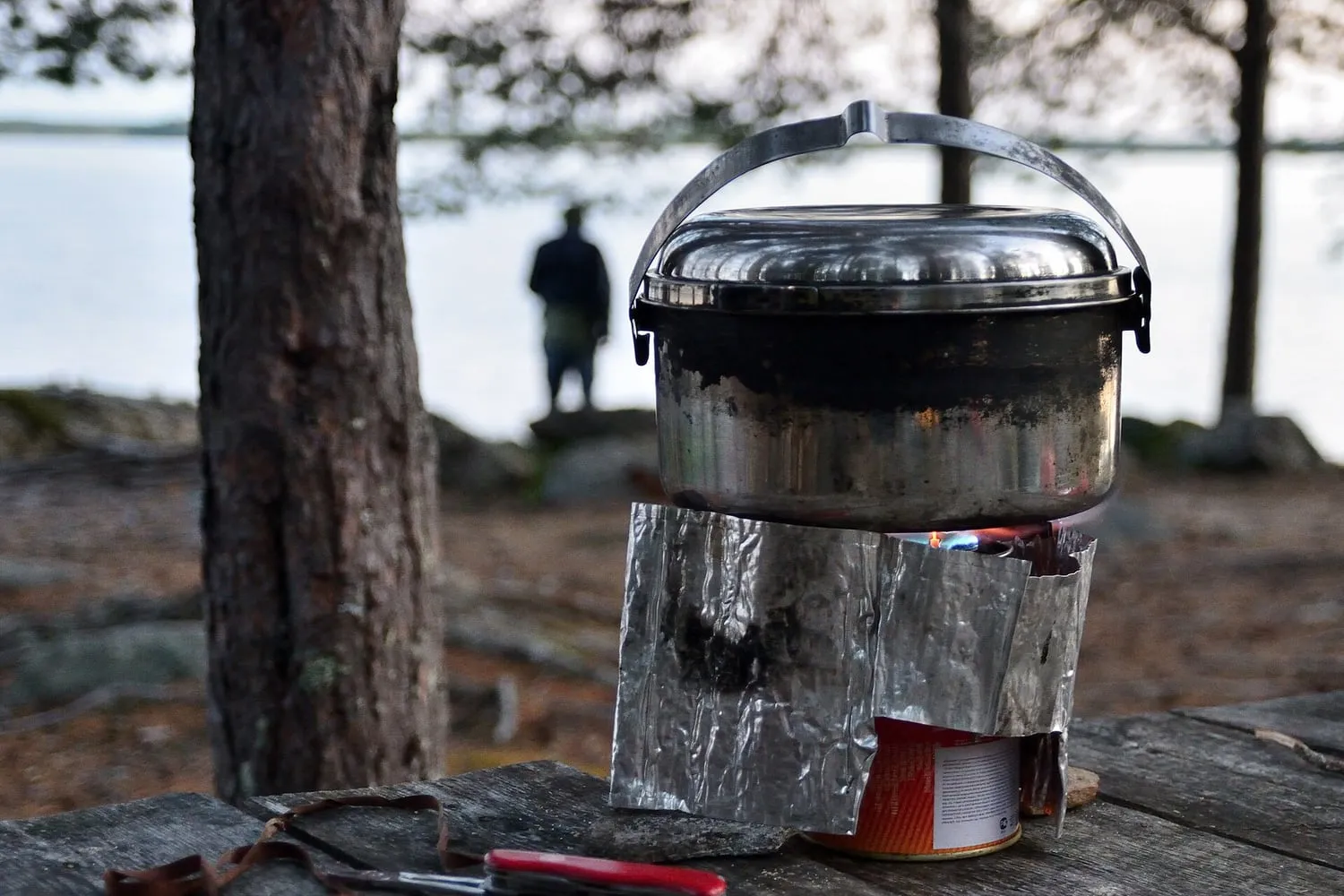
Windshields are where most of the efficiency is won and where most of the safety risk sits. A screen that wraps closely around a canister traps heat, raises the internal pressure and can lead to the canister overheating. A screen should shield the burner and the pot while leaving the canister outside the enclosure, with the base of the screen below the level of the pot and a clear path for hot air to escape upwards. Check the maker’s guidance, since some integrated systems already include the protection and should not be wrapped further.
Choosing the system
Fuel supply is the constraint that decides most of this, and it changes with the trip.
- Count the hot drinks and meals per day, then estimate the fuel, since a small canister boils a limited volume in cool, windy conditions.
- Buy the windshield before the next burner, because it changes consumption more than the burner does.
- Choose a canister system for short trips and mild weather, where replacement canisters are sold nearby.
- Choose liquid fuel where cold, altitude or scattered resupply is expected, and accept the priming and the maintenance.
- Choose an integrated system only if the pot size suits the cooking intended, since nothing can be changed later.
- Carry a lighter and matches, whatever the ignition system claims.
- Weigh the empty canisters and fuel bottles that will be carried out as part of the system, not as an afterthought.