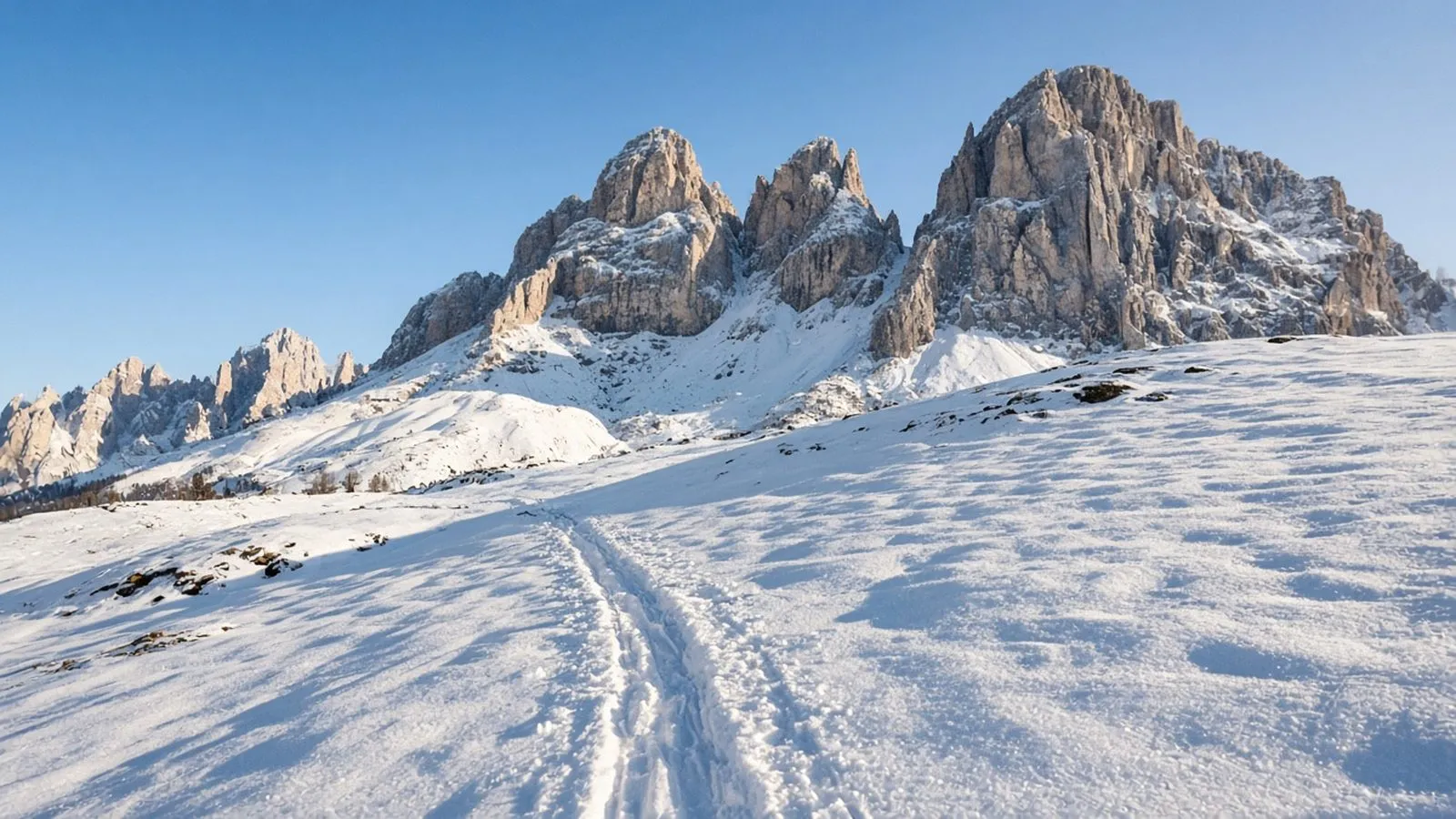
Italy bookings with Heidi, the UK’s second-largest ski holiday operator, are up 107.5 percent year on year for 2026/27, according to figures the operator gave InTheSnow in August. The growth is spread across Piedmont and the Dolomites, with Sauze d’Oulx especially popular.
Most of those people are going to ski. Some of them, or their partners, or their parents, won’t. If that’s you, a snowshoe day in the same valleys is a fine way to spend a winter week, and it asks a different kit list from the one the skiers in your chalet are packing.
This isn’t a trip report. I haven’t walked these specific routes this season. It’s a planning guide: a typical snowshoe day laid out from first light to dusk, and the gear decisions that turn up at each point. Pick your route with local guides or the tourist office, and check the avalanche bulletin every morning.
Getting there
Two pieces of travel news make the Italian side easier this winter.
The Eurostar Snow train runs from 19 December 2026 to 28 February 2027, per InTheSnow’s roundup of new ski options. Check its stops and onward connections against your valley before you rule it out; a train plus a transfer can beat a flight on a winter Saturday.
On the French-Italian border, Montgenèvre is replacing its 40-year-old Chalvet chairlift with two new gondolas for 2026/27. It connects to the Milky Way area, which takes in the Italian resorts of Sestriere, San Sicario and Sauze d’Oulx. If you’re staying in that corner of Piedmont, a gondola is far kinder to a snowshoer than an open chair. You can ride up with your snowshoes in hand and your boots on.
One date to know if you’re planning late season: Easter Sunday falls on 28 March 2027, earlier than this year. Heidi says that’s pulling late-season bookings forward.
Before dawn: the boot decision
You make the most important kit choice of the day before you leave the room.
Snowshoes strap onto a boot, so the boot does the real work of keeping your feet warm and dry. A waterproof winter walking boot with some insulation is the safe choice. A summer three-season boot can work on a short, sunny, low day, but you’ll be standing in snow for hours, and that’s when cold feet start. The binding straps also press across the top of the foot, so a stiff, supportive upper helps.
Fit the snowshoe bindings to your boots at home, or at least the night before. Fiddling with frozen straps and cold fingers at a trailhead is a miserable way to start. Our piece on hiking boots versus trail shoes explains why stiffness and ankle height matter more once you’re on snow.
Gaiters go on now too. They keep snow out of the boot cuff when you sink in, and you will sink in.
Morning: the climb, and the layering mistake
The first hour usually goes uphill, and the mistake almost everybody makes is starting too warm.
You leave a heated room into a cold valley and reach for the big jacket. Twenty minutes up a slope on snowshoes, you’re soaked in sweat under it, and that sweat goes cold the moment you stop. Start a little cold instead. A wicking base layer, a light fleece or grid-fleece, and a shell in your pack. You’ll warm up within ten minutes of climbing.
Snowshoeing is harder work than it looks. Lifting a wider platform with every step, often in fresh snow, raises your effort level well above a summer walk at the same pace. Plan your layers around that effort, not around the thermometer. Our layering and insulation guide covers the system in more detail.
Poles matter more on snow than on rock. Fit snow baskets, the wider discs, so the tips don’t plunge through soft snow. Most adjustable trekking poles take them.
Late morning: the high point
This is where the scenery pays you back, and where the weather can turn.
In the Dolomites, the limestone walls create deep shade on north-facing slopes even on a bright day. In and out of shade, the temperature you feel changes a lot. Pull on your insulated jacket the moment you stop, not when you start to feel cold. A synthetic insulated jacket is the better choice for a wet, active day, because it keeps more warmth when damp than down does.
Sun is the other surprise. Snow reflects a great deal of light, and at altitude it’s strong even in mid-winter. Category 3 or 4 sunglasses or goggles, sunscreen on your face and the underside of your nose and chin, and lip balm with SPF. People who would never forget sunscreen in July forget it in January.
Avalanche terrain is the one thing a planning guide can’t decide for you. If your route crosses or runs below steep open slopes, you need a guide or the training and kit to travel there: transceiver, probe and shovel, and the knowledge to use them. Many marked snowshoe routes near resorts avoid avalanche terrain entirely. Pick one of those if you’re not trained.
Midday: lunch and warm hands
Stopping is when you get cold. Have your insulated jacket out before you sit down, and something to sit on. A foam sit-mat weighs almost nothing and stops snow melting through your trousers.
A flask of something hot does more for morale than any piece of kit. Eat properly, because you’ll be burning more than you think. And look after your hands: a pair of thin liner gloves for fiddly jobs, and warm mitts or insulated gloves over the top. Mitts are warmer, gloves are handier. I’d carry both and a spare pair, because wet gloves are useless and gloves always get wet.
Afternoon: the descent
Going downhill on snowshoes is where knees and ankles complain. Lengthen your poles a little. Keep your weight slightly back and your heels down to let the crampons under the binding bite. On steep or icy descents, snowshoes are not always the right tool; sometimes it’s safer to take them off and walk in boots, or to turn around.
This is also when the light starts to go flat. Low cloud or late-afternoon shade can make it hard to read the snow surface, so bumps and dips disappear. Slow down. Yellow or orange lenses help in flat light if your sunglasses take them.
Dusk: the part people under-plan
Winter days are short, and the Alps make them shorter, because the sun drops behind the peaks well before it sets on the horizon. Plan your finish for well before the official sunset.
Carry a head torch anyway. Check the batteries before you leave, and keep spares warm in an inside pocket, because cold drains them faster. Our guide to head torches and shorter days covers what to look for.
What I’d actually pack
If I had to cut the list to what matters most, it’s this. Warm waterproof boots that fit your bindings. Gaiters. Snow baskets on your poles. A thin base and mid layer to start, a synthetic insulated jacket and a shell in the pack. Spare gloves. Strong sunglasses and sunscreen. A flask. A head torch. And, if your route goes anywhere near avalanche terrain, a guide.
Most of that you can hire or borrow in a resort town. The boots I’d bring from home, already broken in. Everything else is negotiable.