A tent is a filter with two jobs. It has to stop rain, wind and - in winter - spindrift. It also has to let out the moisture you produce while sleeping, or that moisture condenses on the inside of the fly and wets your sleeping bag anyway. Most tents are bought entirely for the first job, and then judged in the morning on the second.
Almost every decision in shelter design is a trade between those two jobs, plus weight and cost.
Single wall or double wall
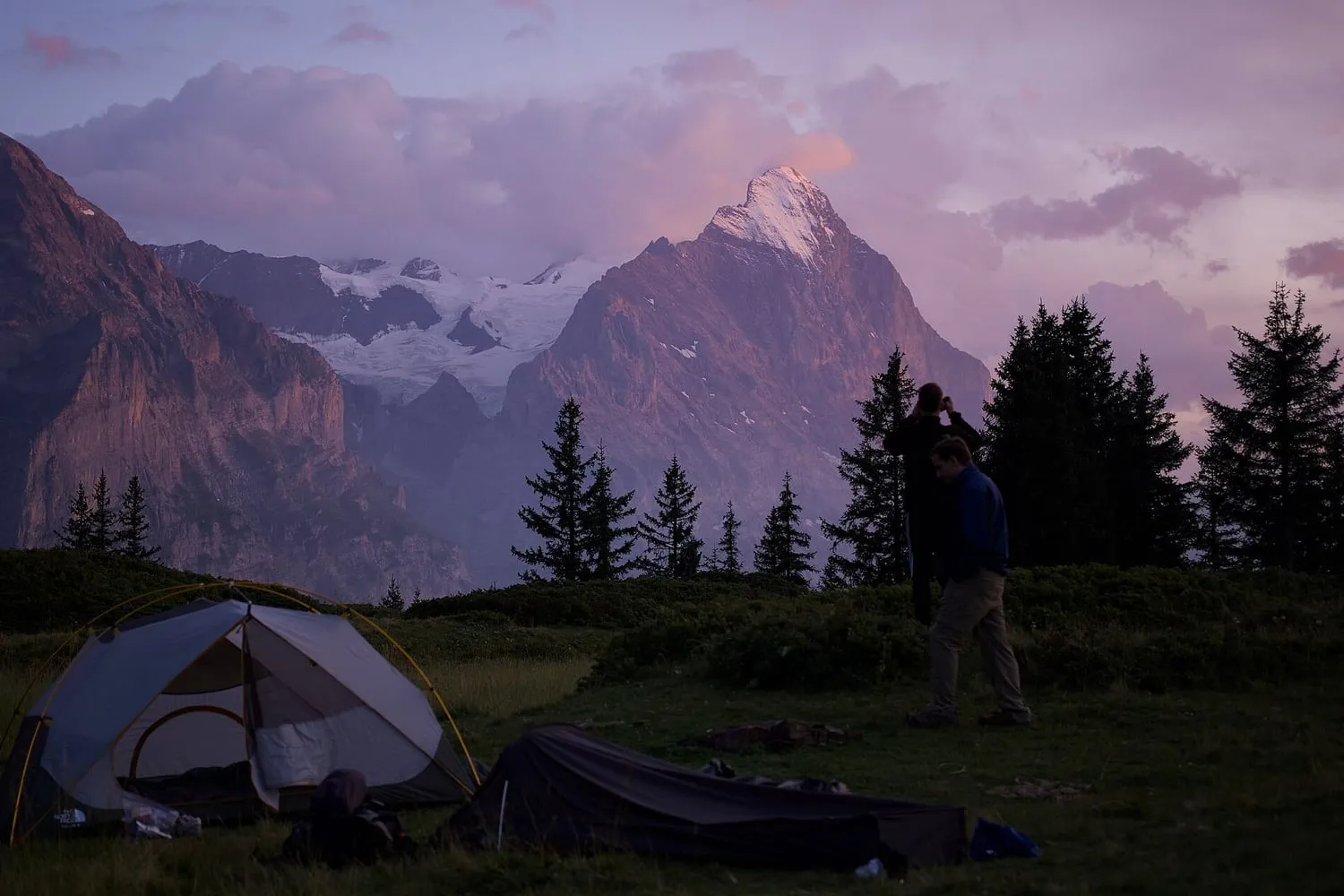
A double-wall tent has a separate inner and a fly. The inner is often mesh or has large mesh panels, which is the main ventilation path, and the fly keeps the rain off. The gap between them is what reduces condensation: moisture that condenses on the fly runs down the outside of the fly rather than dripping onto you. This is the design that suits most three-season camping.
A single-wall shelter combines the two into one fabric: light, simple, fast to pitch and often very strong for its weight. Its weakness is ventilation and dripping. There is no gap to hide behind, so condensation forms inside the tent fabric and, if the tent is knocked or the night turns cold, it drips onto your bag. Single-wall shelters can work well in cold, dry conditions where condensation is minimal, and poorly in damp, still conditions where it is at its worst. Many designs mitigate this with large vents, but ventilation is a compromise against warmth, wind resistance and simplicity.
Neither is objectively better. A double-wall tent that ventilates well will be drier in a wet climate. A single-wall shelter that you pitch with the doors open in the right weather will be lighter and quicker.
Freestanding, tunnel and the shape of the problem
Pitch types sort into three broad groups.
Freestanding domes and semi-geodesics hold their shape without pegging and can be moved after pitching. They handle wind from any direction, they work on rock where a peg will not go in, and they are usually the easiest to pitch in poor weather. The cost is more poles, more weight and more fabric.
Tunnel tents use two or three hoop poles and rely on pegging and guy lines for their structure. They resist wind very well when pitched end-on to it, they offer a lot of space for their weight, and they are usually the cheapest per square metre of floor. They are miserable to pitch on hard, rocky ground, and they do not like side-on wind or snow loading, which can collapse the hoops.
Wedge and A-frame shelters sit between the two, with a simple, weather-facing profile. Many lightweight trekking-pole shelters are variations on this.
Whatever the shape, the number of pegging points and the quality of the guy lines decide how the tent behaves in wind. A tent designed for exposed ground will have plenty of both, and will be pitchable without needing perfect ground.
Poles and fabrics
Aluminium poles dominate. They bend rather than shatter, and a bent section can usually be sleeved with a repair tube and continued. Carbon poles are lighter and stiffer, and they fail less gracefully - a broken carbon section shatters and cannot be repaired in the field. For trips where a pole failure means walking out, aluminium with a repair sleeve is the pragmatic choice.
Fly fabrics are the biggest source of variation.
- Silnylon is strong, packs small and is relatively cheap, but nylon absorbs a little water, which makes it heavier when wet and causes the fabric to sag overnight. Re-tensioning the guy lines in the morning is normal.
- Silpoly is polyester-based: it absorbs far less water, sags less and is dimensionally more stable, with slightly lower tear strength than the best nylon. For long, wet trips it is often the better fabric.
- Laminated fabrics used in the lightest shelters are very strong for their weight, expensive, bulkier than the same weight of woven fabric, and less tolerant of repeated folding along the same line.
- Polyester flies on cheaper tents are usually heavier and hold up to ultraviolet light reasonably well, but they stretch and sag less predictably than nylon.
Whatever the fabric, the weak points are the same: seam stitching, zip entries and the groundsheet. UV exposure degrades all of them, which is why a tent stored pitched in the sun ages faster than one used and put away dry.
Ventilation is the specification nobody quotes
In wet, humid conditions, condensation is the most common reason a night is uncomfortable. It comes from your breath and skin, and it appears on the coldest surface inside the tent - usually the fly, but sometimes the inside of the sleeping bag.
Things that help, in rough order of effectiveness:
- A pitch that puts the low vent into the wind and the high vent downwind, so air can move through and out.
- A fly that does not reach the ground, or has vents you can open and close, so air has a path underneath.
- Two doors rather than one, so the tent can be cross-ventilated regardless of wind direction.
- An inner with large mesh panels, which keeps the fly’s condensation away from your bag.
- Camping on a dry, breezy spot rather than at the bottom of a still valley, which is worth more than any tent feature.
A “four-season” or “expedition” tent is often built strong, with small vents and a fly that reaches the ground. It stops spindrift and wind effectively, and in a humid valley in autumn it will condense heavily. That is not a defect; it is the design decision. Match it to the season you will actually camp in.
Size, weight and what you are paying for
Floor dimensions matter, but so does mat size. Two regular mats and two sleeping bags take more width than the quoted floor area suggests, and a taper in the foot end reduces usable space. Measure the mats and compare the actual rectangle.
Weight is mostly poles, fabric and pegs. Buying a lighter tent is buying thinner fabrics and fewer poles, with more care needed in use and a shorter life. If you camp in sheltered sites and carry the tent a long way, that trade is often worth it. If you camp in exposed places, weight is a poor place to save.
Finally, spares. Guy lines, pegs, pole sections and groundsheets all wear out or get lost, and a tent that can be repaired - by the maker or with spare parts - will outlive one that cannot. Pitching it once or twice at home before a trip, in the rain if you can manage it, tells you more about whether you chose well than any specification.